Why doesn't everyone read comics?
In which I have theories.

Welcome back to Graphic Novel Insider, the newsletter about comics publishing. Today’s topic is: Why doesn’t everyone read comics? Or, put another way, Why do so many people consider comics NOT REAL BOOKS?
When my daughter was in elementary school, I was the parent in charge of the school book fair. Her NYC public school did not use Scholastic, rather a local independent book warehouse that gave the school a larger percentage of book sales, but also meant us parent volunteers were in charge of merchandising. Two years in, I’d had enough of explaining to parents that graphic novels are indeed real books (much realer, IMHO, than those paperbacks that are blister-packed with plastic jewelry, but no one’s complaining about those), and I came up with a plan.
Instead of putting all the graphic novels on the graphic novel table, a long-standing tradition at this book fair, I was going to shelve them by age. So Real Friends was going to go next to the Princess in Black books. Smile would go with the middle-grade prose. Amulet would go next to Harry Potter. All real books, on real book shelves.
Reader, the plan was not a success.
Not only did every. single. child. walk into the book fair and ask “Where are the graphic novels?” but we ended up selling fewer books overall (and those numbers lined up suspiciously with the number of graphic novels we had stocked). So the next year we went back to the graphic novel table and I went back to explaining that these are indeed real books.
But why did I have to do this? Why did parents not want their kids reading graphic novels? Is it possible that this is a vestige of the Comics Code Authority and the idea that comics—like video games after them—led to depravity? There may be something there, but most of these parents grew up well after the CCA, when the Super Friends was on TV, and comics and cartoons were pretty anodyne. And in my conversations with parents, it seemed to come down to two things:
Kids actually like them. Somehow we seem to have instilled this idea that reading should be a slog. (This is the same reason so many people think “reading” audio books doesn’t count!) But reading is reading! Of course everyone should strive for a balanced reading diet that includes a lot of prose (and prose need not be a slog either!), but giving kids books they LIKE to read is an important part of that.
Kids read them really quickly. And parenting is expensive. I get that parents want to spend money on books that will take kids longer to get through. And I’ve heard more than one graphic novel author recount a book signing at which a young reader, having reached the signing table, announced “I read this whole book while I was in line!” (Now MAKING graphic novels IS a slog.) But these same kids will read this book over and over. And they will probably discover something new every time!
(Side note: I really love when graphic novel creators take advantage of the re-read. In Svetlana Chmakova’s Awkward, for instance, readers learn at the end that there is a raccoon hidden in at least 20 places throughout the book! Cue immediate re-read.)
Why do parents draw these conclusions about graphic novels though? Because—by and large—they did not grow up reading them. Here’s where my theories come in:
So most of us were introduced first to picture books. We could see the words but we probably couldn’t read them, so they were read aloud to us. What we could do, though, was interpret the pictures. These scaffolded the storytelling and gave us our first step toward visual literacy. And all of the best picture books contain story details (and sometimes entire subplots) that are only in the illustrations. So we began to learn how to read illustrations, and interpret their meanings.
And then we graduated to chapter books. Exciting times! We were reading on our own! But now the illustrations were there for decorative purposes only. They beckoned us in, but they didn’t tell us anything new. We were being told that textual literacy is more important. So our visual literacy muscles atrophied.
(Another side note: Diary of a Wimpy Kid was one of the first text-based books for middle-grade readers that brought visual storytelling back. In these books, if you remove the illustrations, you are removing important chunks of the story; the books can’t be read without them. Cue readers’ renewed interest in visual storytelling, i.e., graphic novels.)
And then, at some point, the illustrations were removed all together, relegated to front covers only. (Wait, is this why we are so hot for deluxe editions right now? Those physical books that add visual elements like illustrated end papers and stenciled edges?) And so our ability to read images—our visual literacy—essentially died on the vine. And reading comics—where at least half of the storytelling load is carried by the images—became a skill we just didn’t have.
And this is why (IMHO) so many adults who grew up in the pre-Wimpy Kid era do not think of graphic novels as real books.
And this has repercussions beyond just the book fair.
Just this past year I found myself in a conference room full of independent sales reps. My job was to introduce them to the graphic novel list (that they had ostensibly been selling to bookstores for the past five years, but that’s another rant). It was an exciting opportunity—at big publishers you rarely get the chance to connect personally with a room full of the folks selling YOUR books (because they sell thousands of books a year and cannot possibly meet with every editorial director and still also do their jobs). And a lot of the feedback was great! These people had read and loved many of the books on our graphic novel list. But then…
“I’m just not a graphic novel person,” someone said. And then someone else agreed! “I just have trouble reading them.” To be clear, they were not telling me that they were shirking their responsibilities to present out graphic novels to retailers. But they were admitting to not reading them. To not understanding them. And in a business supposedly built on passion (a topic for a future newsletter!), this told me that my books were not getting the same love and care as other books.
A lot has changed in the world of graphic novels in the past 15 years. There have been some weeks when a Dog Man book was the best selling book—of any format or genre—in the US. But we still have a ways to go before everyone sees graphic novels for what they truly are: real books.
Some graphic novels you should know about:
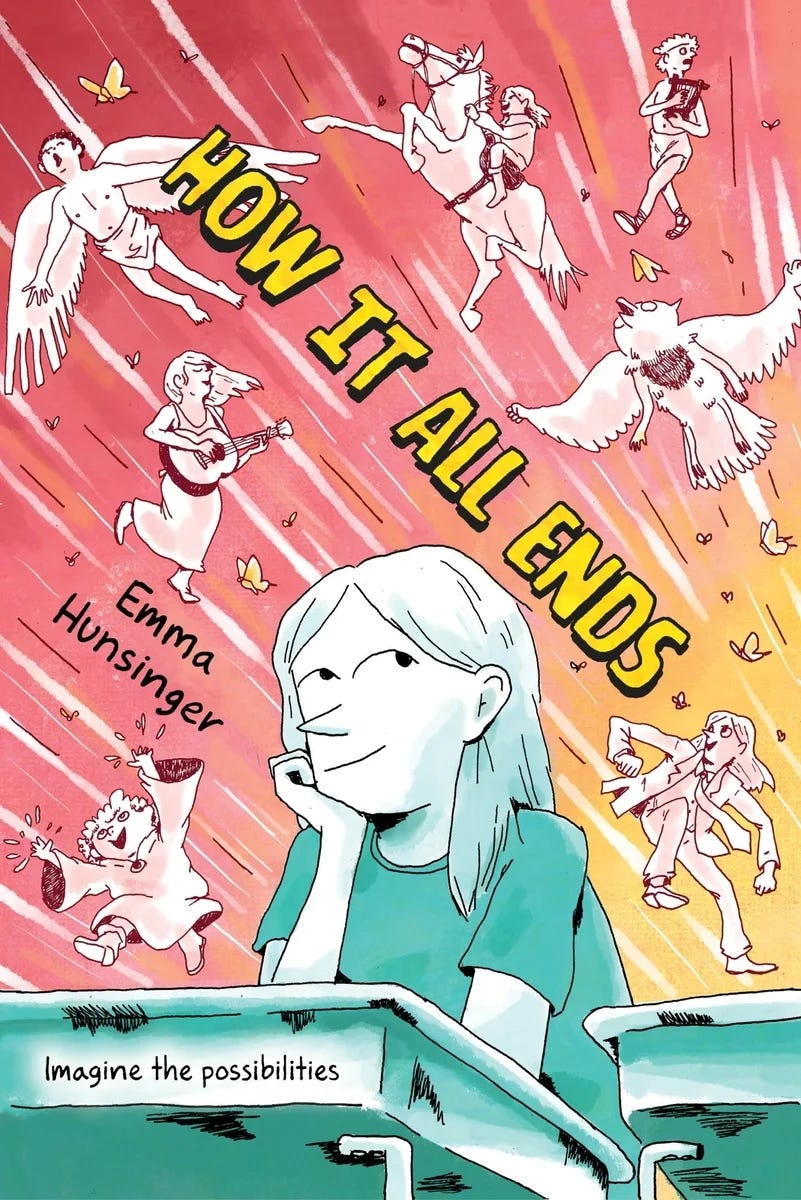
How It All Ends by Emma Hunsinger. One of the most original graphic novels I’ve read in years.
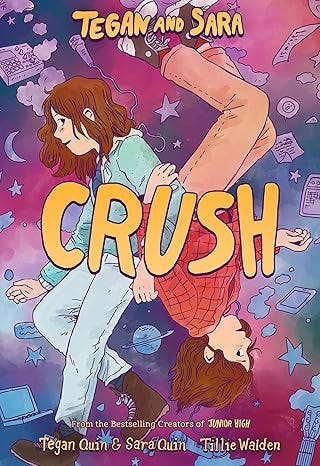
Tegan and Sara: Crush, illustrated by Tillie Walden. An artistic and queer awakening from two different perspectives.
This was fun!! Graphic Novels are a great way to get people who don’t have a lot of time to read back into the hobby. It feels like less commitment. I’m a high school teacher and I spend a lot of time trying to come up with ways to get young adults reading more, especially boys or those with specific learning disabilities based around reading. I have ADHD so I tried to use myself as practice back in grad school (2018) when I was reading a million heavy scientific papers and had very little energy for reading in my free time. Junji Ito’s Uzumaki gets full credit for pulling me back in. It took years but that small “hook” of the graphic novel took me from reading maybe one full book a year to present day where I’m reading 50+ a year.
Interesting article. Graphic novels are quicker to read and therefore can be re-read more easily. One truly appreciates a book on the 2nd reading IMO